

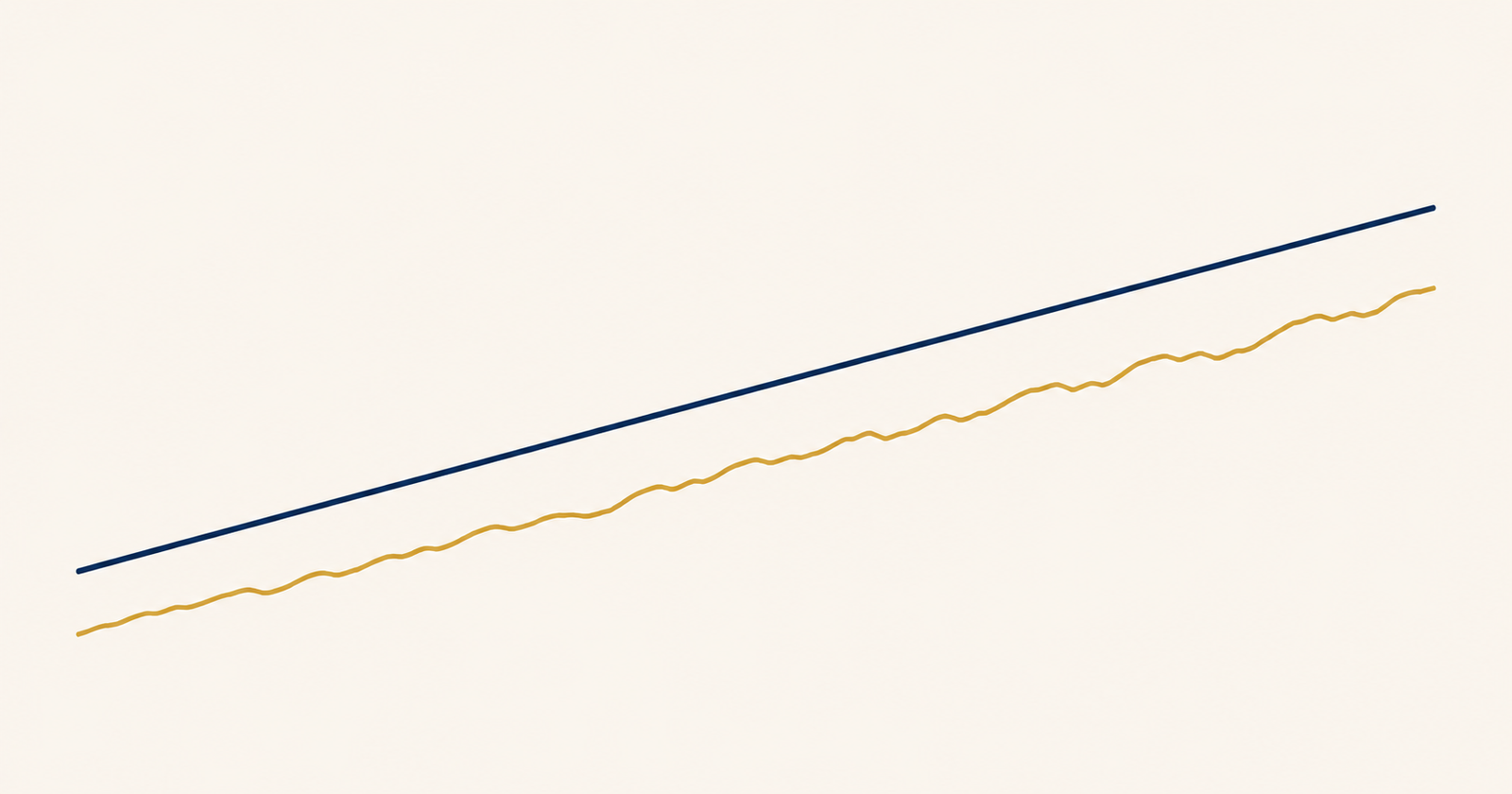
Index funds vs actively managed funds gets framed as a philosophical debate more often than it needs to be. It’s really a simpler question underneath: is the extra fee an active fund charges actually earning its keep, or not? Worth answering with data rather than opinion, since both sides have strong ones.
Index funds vs actively managed funds: what each is doing
Going back to the mutual fund = bus idea from an earlier post: an index fund is the fixed-route public bus — it goes exactly where the index goes, no detours, no driver judgment involved, and a low fare because there’s no route-planning to pay for. An actively managed fund is more like a shared shuttle whose driver tries to find a faster way there — sometimes it genuinely does, but you’re paying extra for that judgment either way, whether the shortcut works out or not. An index fund simply buys and holds whatever’s in a market index — the Nifty 50, for instance — in the same proportions, and its return tracks the index closely, minus a very small fee. An active fund has a manager deciding which stocks to hold, trying to beat that same index, and charges a meaningfully higher fee to fund that research and decision-making.
What the data actually shows, not just the theory
S&P’s SPIVA India scorecard tracks exactly this question every year — what percentage of active funds actually beat their benchmark index, after fees. The results are more one-sided than most people expect: over the 10-year period in the most recent scorecard, 73% of large-cap active funds failed to beat their benchmark, and over 5 years that figure rose to roughly 90%. The genuinely surprising part is that mid- and small-cap funds — the segment often assumed to be where active managers have the biggest edge, since those stocks are researched less — showed an even higher long-term underperformance rate, at 82% over 10 years. A single strong short stretch for one category (mid/small-cap funds did do well over the first half of 2025 specifically) doesn’t undo that longer pattern — it’s a reminder that short-term outperformance isn’t the same thing as a reliable long-term edge.
Why the fee gap matters so much over a full sailing career
The fee difference between an index fund and an active fund looks small in any single year — often just a percentage point or so — but fees compound the same way returns do, just working against you instead of for you. Over the kind of multi-decade horizon we’ve written about in the power of compounding, even a modest extra fee, paid every single year, adds up to a genuinely large dent in the final corpus if it isn’t being offset by real outperformance.
Why time horizon and market conditions change the answer
The SPIVA numbers above are long-term averages, blending together whatever mix of trending and range-bound years happened to fall in that stretch — they describe the past, not what’s coming next. An index fund is structurally built to mirror whatever the index does, nothing more and nothing less. In a market that genuinely goes nowhere for a while — moving sideways instead of trending up — the index fund goes nowhere with it, and once even its small expense ratio is subtracted, it can quietly deliver a small loss over that stretch. An active fund manager isn’t bound the same way: they can rotate between sectors, book gains near the top of a range and buy back lower, or hold more in cash when nothing looks attractively priced — potentially pulling out real returns from a market an index fund would just sit through, flat. That flexibility is exactly what the higher fee is meant to be paying for.
None of this flips the long-term data on its head — a manager still has to exercise that flexibility well, and the SPIVA years already include plenty of range-bound stretches, yet most active funds still fell short across them. But it does mean this isn’t a decision to make once, in the abstract, and leave alone. It’s also about the kind of market you’re actually investing through and how long you’re staying in for. A multi-decade SIP that will run through several different kinds of markets — trending and range-bound both — is a different bet than money going in for a shorter, more specific stretch where a skilled manager’s flexibility has more room to actually matter.
So which one should you actually pick
Index funds vs actively managed funds isn’t a rule to apply blindly — the data leans toward cost mattering more than most people assume, but it isn’t universal — some active funds genuinely do beat their benchmark, consistently, over long periods, and past underperformance industry-wide doesn’t mean every fund underperforms. This is exactly the kind of scheme-selection decision worth working through against your own goals and risk profile, rather than picking a side in the abstract. AMFI’s investor education material covers the mechanics of both fund types if you want the fuller picture before deciding.
This post is general education based on published SPIVA India data, not a recommendation of any specific fund. As an AMFI-registered Mutual Fund Distributor (ARN 185676), we help clients work through this exact trade-off for their own portfolio. See our Investment Options page or get in touch to talk through yours.
More From The Log
